The invention of ship propellers actually originated from an accident!
Large engineering ship propellers - Thousands of years ago, our ancestors discovered the difficulty of crossing rivers. In the past, small rivers and streams were all crossed by wading. Later, people discovered that trees could float on water. If the thick trunks were dug out, wouldn't it be possible to sit on people? So, the primitive ship was born!
Large engineering ship propeller - how does the ship walk in water? Later, people observed the way fish swim in water and invented oars.
Large engineering ship propellers - Thousands of years ago, our ancestors discovered the difficulty of crossing rivers. The first small rivers and streams were all crossed by wading.
Large engineering ship propellers - Later, people discovered that trees could float on water. If the thick trunks were dug out, wouldn't it be possible to accommodate people?
Large engineering ship propellers - thus, the primitive ship was born! So how does a boat walk in water? Later, people observed the way fish swim in water and invented oars.
Large engineering ship propeller - how can a ship navigate in water with high speed and low manpower? As early as two thousand years ago, Archimedes invented a cylindrical spiral water lifting device - the "Archimedes spiral". Through this device, he successfully irrigated the soon to dry land with Nile water, solving the problem for the farmer uncle.
30M patrol boat propeller - In 1853, inspired by the Archimedean spiral, British engineer Smith and Swedish engineer Erikson began the development of ship propellers.
A 30M patrol boat propeller was obtained and finally invented a propeller a year later. Its shape was similar to Archimedes' waterwheel, with two pitches equivalent to three rows of screw threads. If it was turned once, the screw threads could enter two circles. Due to the lack of complete theoretical support at that time, he assumed that the more circles there were, the higher the efficiency would be. However, due to the large number of circles, the experimental results were not ideal.
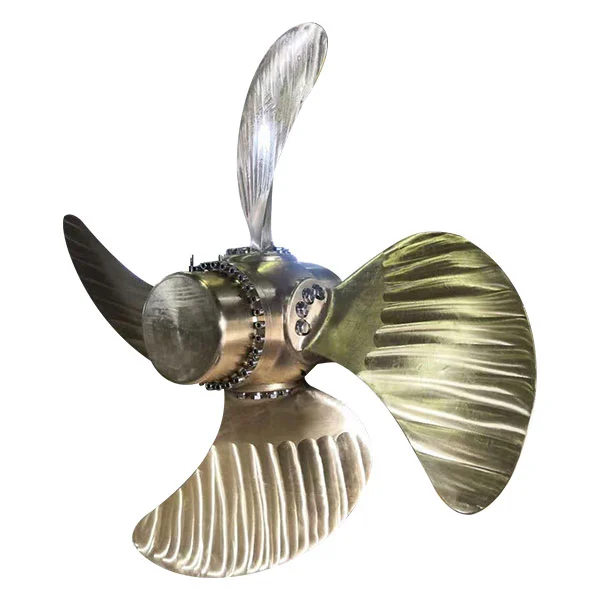
Marine propellers are generally composed of 4-6 blades, each of which maintains a certain angle of attack with the fluid when rotating around the axis, thereby generating forward lift to propel the ship forward. During the navigation of a ship, the water flow velocity around the hull is almost equal to the sailing speed, but at the stern of the ship, the water flow velocity is lower than the ship's sailing speed.
30M patrol boat propeller - "pitch angle" refers to the angle of each blade on the propeller shaft. When the pitch angle changes, the angle of attack between the blade and the water flow will also change accordingly, and the lift received by the blade will also change accordingly.